
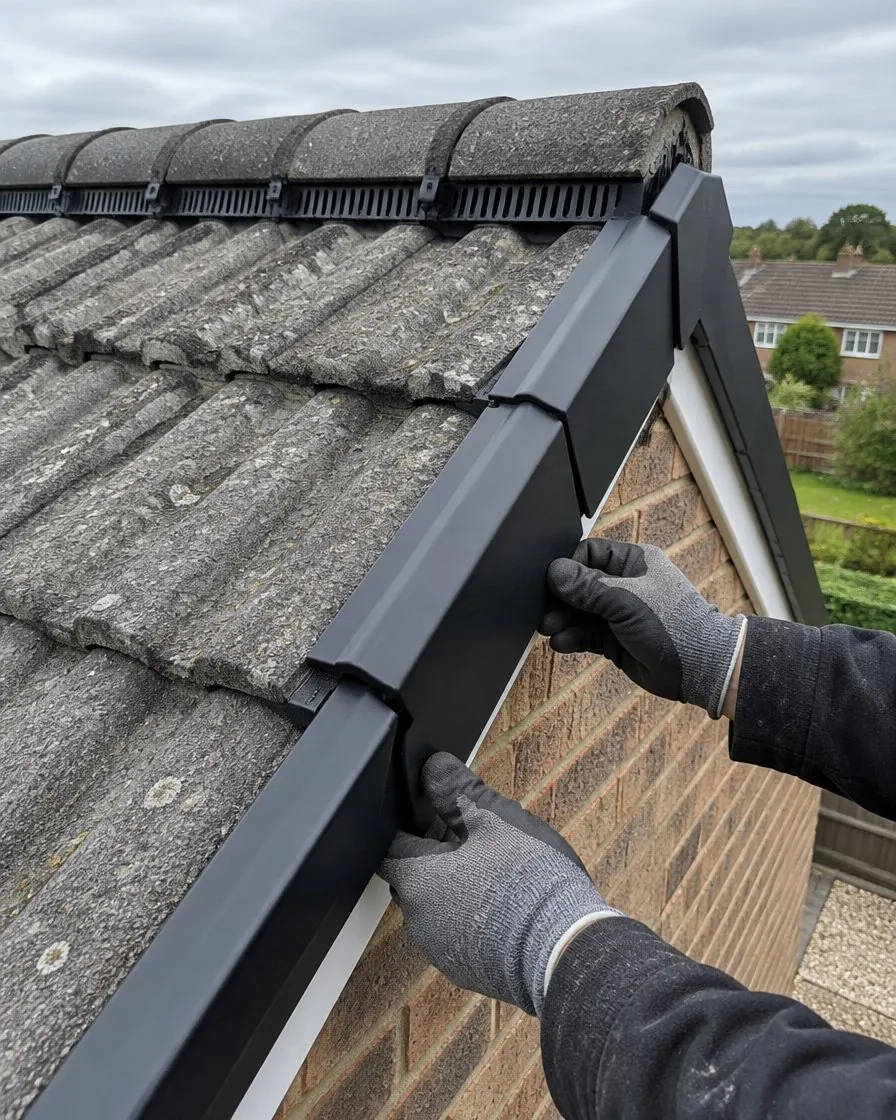
Look along any street of tiled roofs in Mousehole after a storm and you'll see the same damage: a ridge tile missing here, a chunk of mortar on the drive there, and the gable ends with their pointing long gone. Traditional roofs have the ridge tiles bedded in mortar and the tiles at the gable edge, the verge, pointed with it. Mortar is fine on the day it's laid. Within a few years in Cornwall weather it cracks, the cracks let water in, frost opens them up, and eventually the ridge tiles work loose and come off in the next gale. Dry fixing systems do away with the mortar altogether.
What dry ridge is
A dry ridge system clamps the ridge tiles down to a ridge batten with stainless steel screws and clips, over a ventilated roll that keeps rain out while letting the roof breathe. Nothing is bedded in mortar, so nothing can crack or fall. The ridge is held mechanically and will stay put in winds that would strip a mortar ridge. Since 2015 the British Standard for slating and tiling, BS 5534, has required ridges and hips to be mechanically fixed, so dry ridge is now what every new and renewed roof in Mousehole should have.
What dry verge is
A dry verge system uses interlocking uPVC caps that clip over the tiles along the gable edge, locking each tile down and sealing the edge against wind and rain. They replace the mortar pointing that is always the first part of a Mousehole roof to fall out. Caps come in black, brown, grey and terracotta to match the roof tiles, and the result is a crisp, finished edge that will never need repointing.
Why it matters in Mousehole
Exposed roofs across Mousehole, TR19 take a battering. The west-facing gables and the ridges of houses on higher ground around Mousehole are the most exposed parts of the most exposed roofs, which is why they're where the mortar fails first and where the storm damage happens. A dry ridge and verge upgrade is the single most effective thing you can do to make an older roof storm-proof. It also ventilates the roof space, which helps stop the condensation and damp timbers that many lofts in Mousehole suffer from since the eaves were sealed up by insulation and soffit replacement.
When to fit a dry system
- After storm damage. If a ridge tile has come off or the verge pointing has fallen, converting to a dry system fixes the damage and stops it happening again. This is our commonest winter call-out in Mousehole.
- As part of a re-roof. Every roof we replace gets dry ridge and verge as standard; it's required and it's better.
- As a stand-alone upgrade. A day's work on a typical semi, done from scaffold or towers, that removes the ridge and verge from your list of worries for good.
- When a chimney comes down. If a redundant stack is removed and the roof made good, the new ridge section is finished dry.
How we fit it
- Old mortar is raked out and the ridge and verge tiles lifted and cleaned, or replaced where cracked.
- A ridge batten is fixed between the rafters at the correct height for your ridge tiles.
- The ventilated ridge roll is fixed over the batten and dressed down onto the tiles.
- Ridge tiles are re-laid and clamped with stainless steel fixings through the roll into the batten.
- Verge caps are clipped on tile by tile, starting at the eaves with a starter unit and finishing at the ridge with an end cap.
- Everything is photographed and the old mortar cleared from the garden and gutters.
Suitability
Dry systems suit the concrete interlocking and plain tiles found on most post-war roofs in Mousehole. Natural slate roofs and some older clay tiles need different details, and a few roofs have ridge tiles that no dry system fits well; on those we'll explain what the right answer is. It's also worth saying that a dry verge is slightly more visible than pointing. Most people in Mousehole, TR19 think it looks neater, and the caps can be matched to the tile colour, but we'll show you a sample before you decide.
Dry ridge and verge as part of a wider roof repair
A dry ridge and verge upgrade in Mousehole is often the first part of a staged plan to bring an older roof back to a good standard without the cost of a full re-roof. We'll combine it with refixing slipped tiles, renewing the lead at chimneys and valleys, replacing a cracked tile here and there, and clearing and realigning the gutters, all in the same visit while the scaffold or towers are up. For a roof in Mousehole, TR19 that is basically sound but has been neglected for a decade, that package deals with every likely source of a leak in one go and leaves the roof storm-proof.
Costs and what affects them
The cost of dry ridge and verge in Mousehole depends on the length of ridge and hips, the number of gables, the access needed and whether any ridge or verge tiles need replacing. A plain gable-to-gable roof on a semi is the simplest case; a hipped roof with several hips and a bungalow with a long ridge take longer. We quote in writing after looking at the roof, and the quote separates the ridge, the verge and any tile replacement so you can see what each costs.
Dry ridge and verge across Mousehole and Mousehole, TR19
Mousehole Roofing is based in Mousehole and covers the whole of Mousehole, TR19. A dry ridge and verge on a typical semi is one day with the scaffold up, and we'll quote from a look at the roof. Call 07723 607 800 or request a quote and we'll arrange a visit.